
Best Bird Foraging Toys: What Actually Keeps a Parrot Busy
Bird foraging toy review across five categories: puzzle feeder, palm shredder, natural foraging box, shred basket, and food skewer. What owners report still gets used a month later, and what to avoid.
As an Amazon Associate we earn from qualifying purchases.
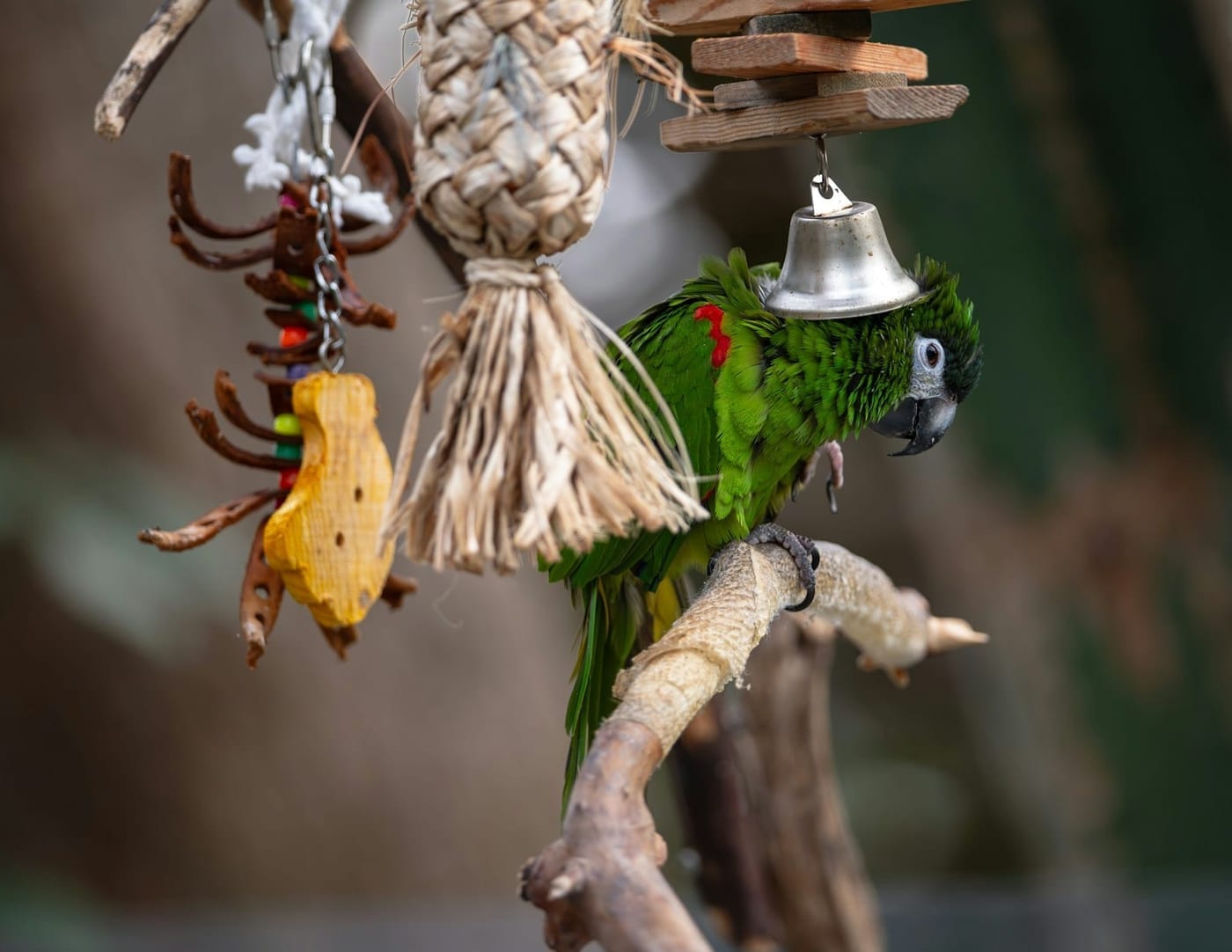
A foraging toy earns its place by making food harder to get, and the ones worth buying share one property: the bird can destroy or empty them, then you reload or replace them. Five picks below cover a clear puzzle feeder, a palm shredder roll, a natural foraging box, a shred basket, and a stainless food skewer.
Prices and stock were checked on Amazon August 1, 2026. This is a research-based review built from listing detail and owner feedback patterns rather than one household’s testing, and every product is real, currently sold, and cross-checked against its own listing.
Why Do Most Bird Toys Stop Working After a Week?
Because most bird toys are objects, and a bird wants a job.
The gap is measurable. Research summarised by LafeberVet puts wild Puerto Rican Amazon parrots at 4 to 6 hours of foraging a day. Captive orange-winged Amazons, filmed and counted, ate for 3 to 4 minutes an hour, totalling 30 to 72 minutes across an entire day. A food dish takes a five-hour occupation and compresses it into forty minutes, and the remaining four hours become the bird’s problem to solve.
What fills those hours matters. In the same research, foraging enrichment and physical complexity prevented and reduced psychogenic feather picking in young orange-winged Amazons, and foraging was associated with significantly improved feather scores. Feather damage often reads as redirected foraging. So the toy that hides food is doing something structurally different from the toy that hangs there being colourful.
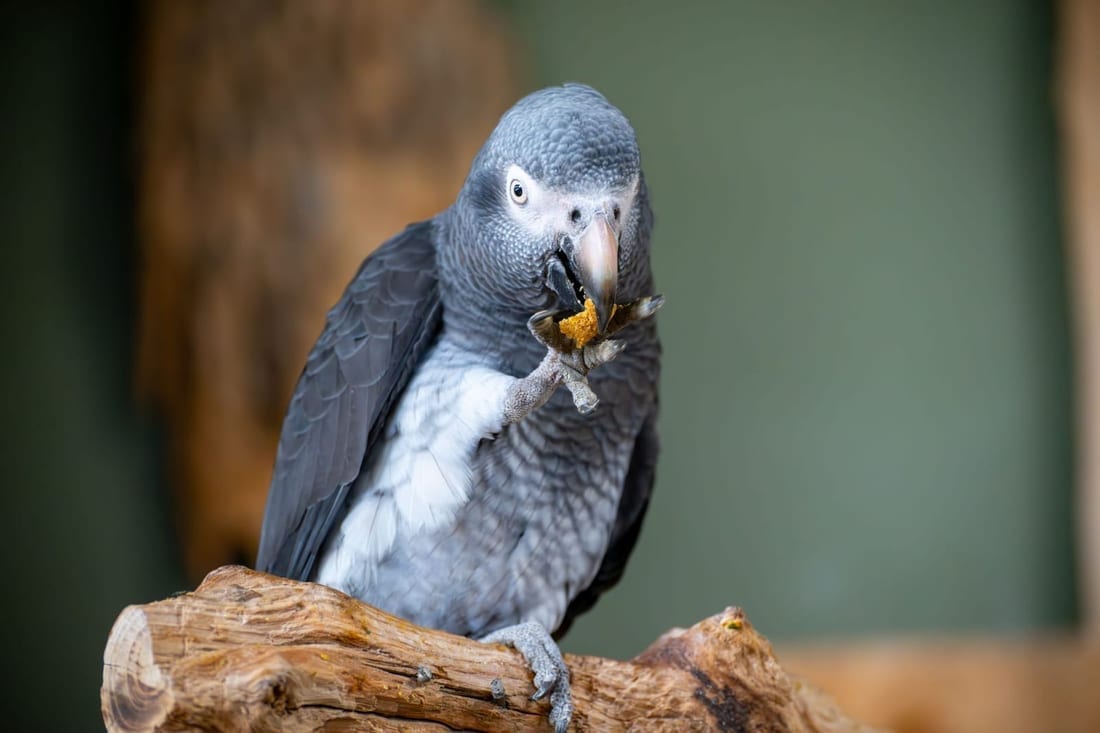
That is the filter applied below. A toy makes this list if it either holds food the bird has to extract, or is destructible enough that dismantling it is itself the activity. A mirror is neither.
| Pick | Best for | Listed price | Rating |
|---|---|---|---|
| Paradise Creative Foraging System Wheel | Medium and large parrots, reusable puzzle | About $39 | 4.4 across 3,663 ratings |
| Planet Pleasures palm shredder roll, 30 ft | Any size bird, best cost per hour | About $8 | 4.6 across 831 ratings |
| Kyouki natural foraging box | Budgies to greys, mixed textures | About $10 | 4.6 across 191 ratings |
| CIEZZU foraging and chewing basket | Small and medium birds, large shred surface | About $15 | 3.9 across 2,556 ratings |
| Stainless steel food skewer, 2 pack | Fresh produce, zinc-free hardware | About $9 | 4.5 across 6,535 ratings |
Prices and rating counts read from the listings August 1, 2026.
Best Puzzle Feeder: Paradise Creative Foraging System Wheel
The Paradise Creative Foraging System Wheel is a clear polycarbonate wheel, 6 inches across, divided into separate chambers you fill with different foods. It mounts on the cage bars and spins, so the bird pushes it round, picks a chamber, and works the food out through the openings. Because it is transparent, the bird can see the payoff before it has learned the mechanism, which is what gets a hesitant bird started.
At around $39 it is by a distance the most expensive thing here, and the listing’s own pitch leans on feather picking and screaming reduction, which is marketing language wrapped around a real behavioural principle. What justifies the price is that it is the only pick on this list that is not consumable. Load it, empty it, wash it, load it again. Across a year the palm roll below will cost more in total.
Two honest limits. Six inches is a medium-to-large-bird object, so a budgie gets less out of it than a conure or a grey does. And a wheel with a visible payoff is easy for a clever bird, so a grey that solves it in two sessions needs the chambers loaded with something harder to shake loose, like a pellet wedged behind a nut, rather than loose seed.
Best Shreddable and Best Value: Planet Pleasures Palm Shredder Roll
The Planet Pleasures Shredders Straight Natural roll is not a toy. It is 30 feet of woven palm leaf on a roll, one inch wide, for about $8, and you build the toy yourself. Cut a length and tie it to the cage bars. Wrap a perch in it. Weave three strips through an existing toy that has gone stale. Cut short pieces into foot toys for a cockatiel. Fold a strip around a piece of dried fruit so the bird has to unwrap it.
That flexibility is why it is the best value on the list by a wide margin, and the listing makes a point the owner reviews echo: soft enough for small birds, cheap enough for the destructive ones. A macaw that reduces a $15 toy to splinters in an afternoon costs the same to entertain as a lovebird.
The catch is that it requires you to do something. A finished toy comes ready to hang. A roll of palm ribbon sits in a cupboard unless you spend two minutes a week cutting and tying. If that is not going to happen, buy a finished toy instead and accept the higher cost per hour.
Best Natural Foraging Box for Small and Medium Birds: Kyouki Foraging Box
The Kyouki natural foraging box is around $10 and its whole argument is texture variety. The listing names pine cones, apple wood, apple wood chew blocks, coconut shells, sola fibre, loofah, spiral seagrass, wicker balls and corn, which is more distinct materials than most birds encounter in a year of single-material toys. You hide treats among the pieces and the bird works through the layers.
Mixed texture is a genuine advantage rather than a listing flourish. A bird that has learned to defeat wooden blocks has not learned to defeat loofah, and the different resistance of each material keeps the extraction from becoming automatic. It sits in the sweet spot for parakeets, cockatiels, conures, lovebirds and parrotlets, and a grey will take it apart faster but still enjoy doing so.
The rating is strong at 4.6, but on only 191 ratings, which is a much thinner evidence base than the 3,663 behind the Paradise wheel. Treat it as promising rather than proven.
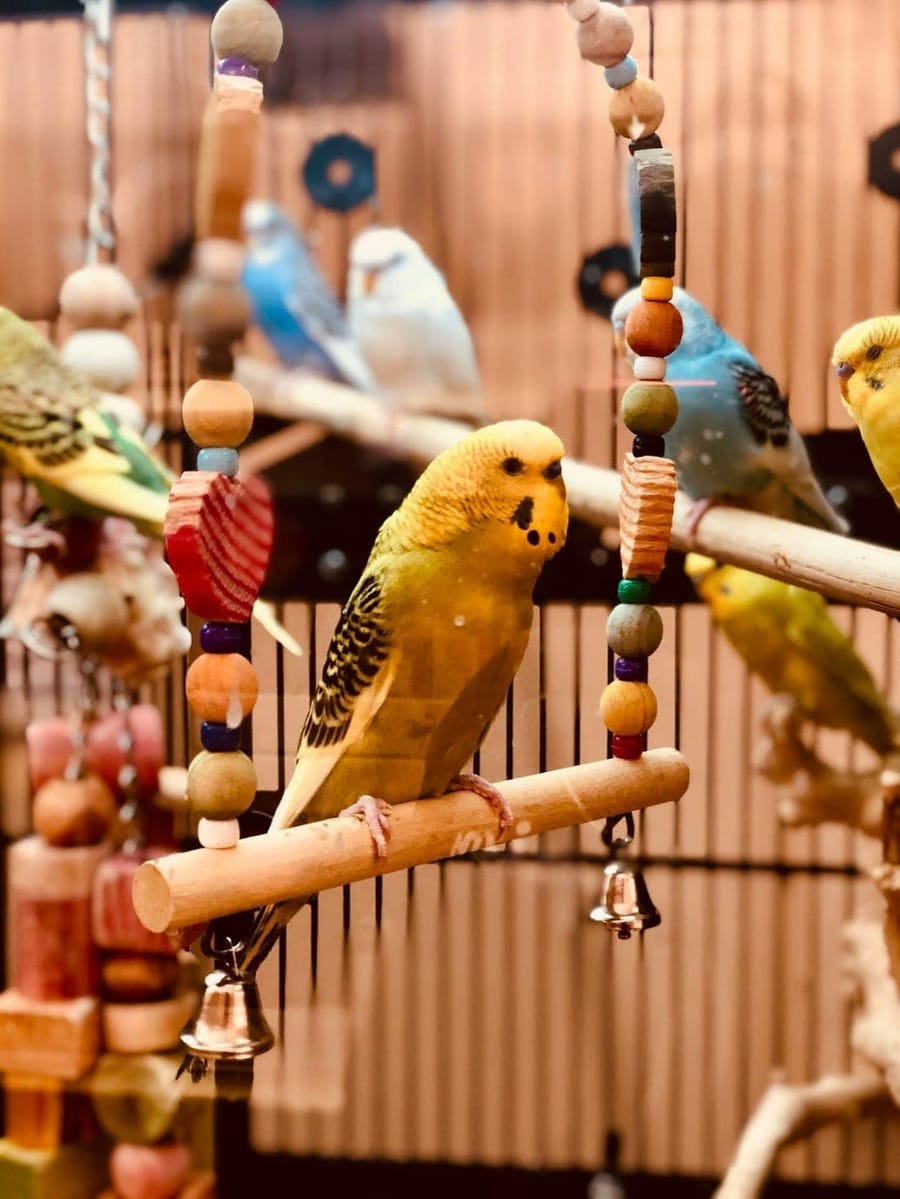
Rotation is the lever that costs nothing. Birds habituate to a toy that never moves and never changes, and a toy reintroduced after two weeks in a cupboard reads as close to new. A workable pattern for four toys:
| Week | In the cage | In the cupboard |
|---|---|---|
| 1 | Puzzle wheel, fresh palm wrap | Foraging box, shred basket |
| 2 | Puzzle wheel, foraging box | Shred basket, palm wrap |
| 3 | Shred basket, fresh palm wrap | Puzzle wheel, foraging box |
The reloadable puzzle stays out more often than the rest because refilling it with a different food is itself a change.
Best Large Shred Surface: CIEZZU Foraging and Chewing Basket
The CIEZZU foraging and chewing set is around $15 for a basket measuring 11.22 by 7.95 inches, studded with 296 small mushroom-shaped pieces the bird pulls off one at a time. The scale is the point: this is a surface a bird can stand on and work across for a long session, rather than a single object it dismantles in one go.
It is also the weakest-rated pick here at 3.9 stars, and that number should change what you expect. A rating in the high threes on 2,556 ratings usually means a product that works well for some birds and disappoints others rather than one that fails outright, and with shred toys the split is normally beak strength. A heavy chewer clears a basket like this quickly. A budgie may take weeks.
Buy it for the sustained flat working surface, which nothing else on this list provides. Do not buy it expecting the durability of the Paradise wheel.
Best Food Holder: Stainless Steel Skewer
The stainless steel food skewer 2 pack is about $9 and it turns fresh produce into a foraging exercise. Unscrew the base, thread on apple, pepper, carrot, mango, kale, whole grapes, reattach, hook it to the cage. The bird has to hold position and work the food off rather than eating it from a dish. Sizes run 8.9 and 10.8 inches, and at 6,535 ratings it has the deepest review base of anything here.
The material is not an incidental detail. VCA notes that chewing on galvanised wire or metal toys has caused zinc poisoning in birds, and that certain imported toys are a known source. A skewer is a hardware item a bird grips in its beak repeatedly, at close range, while motivated by food. Food-grade stainless is the correct answer and plated metal is not.
What About Mirrors, Bells and Cheap Metal?
Three categories fill the bird aisle and none of them is a foraging toy.
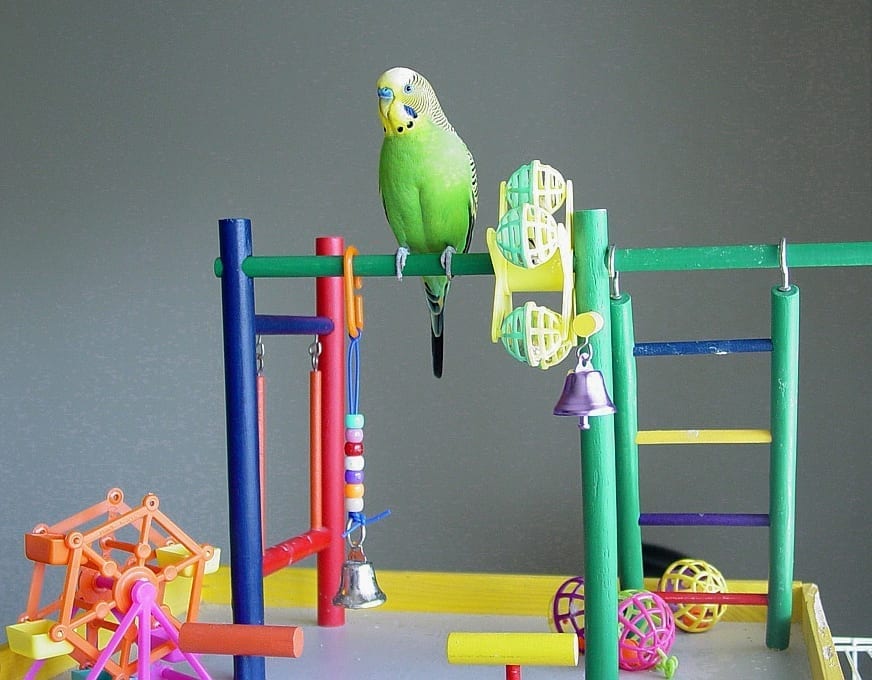
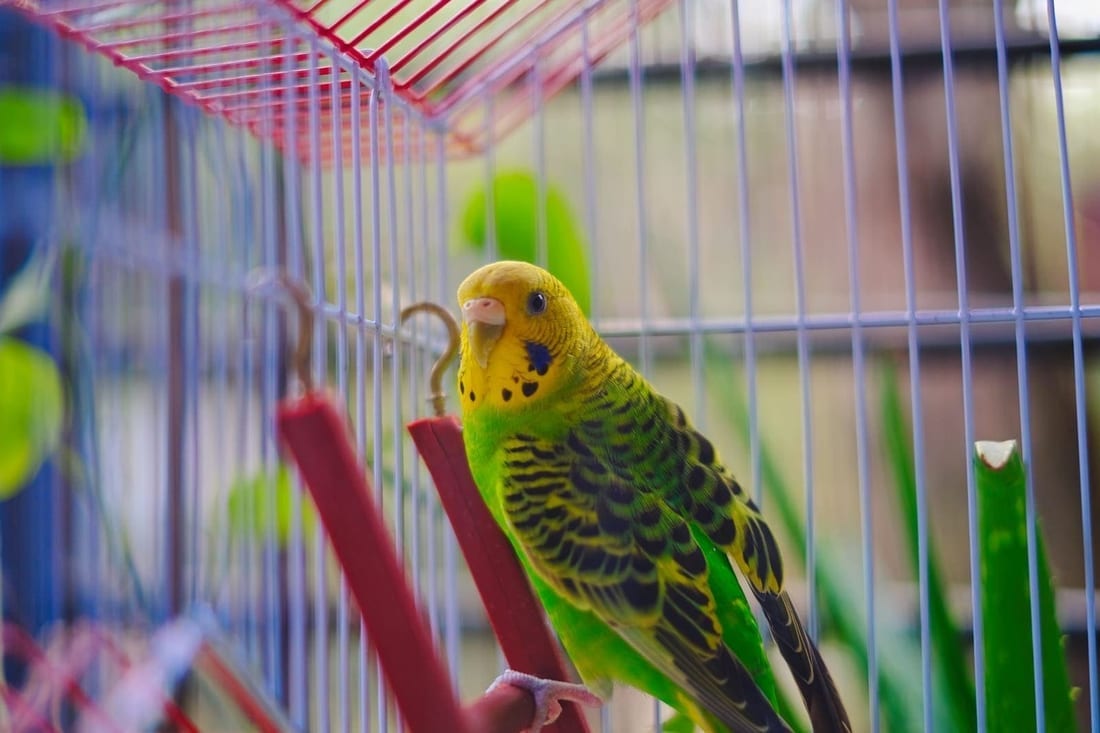
Mirrors are the one to think hardest about. A single-kept bird can pair-bond to its own reflection, and VCA lists removing mirrors and any toy the bird regurgitates onto among the standard responses to hormonal and sexual behaviour problems. Regurgitating to a mirror is courtship feeding aimed at a bird that will never eat, and it can turn into chronic regurgitation. Budgies and cockatiels are the usual cases. If your bird already has a mirror it ignores, this is not an emergency. If your bird sits at the mirror and brings food up to it, take the mirror out.
Bells are mostly fine and occasionally not. The risk is not noise, it is construction: a cheap bell can shed a clapper a bird then swallows, and plated bell metal is exactly the zinc question above. Solid stainless bells exist. Unbranded multipacks of small shiny bells are the ones to skip.
Cheap plated hardware is the quiet hazard. Quick links, chains, skewers and clips are the parts a bird spends the most beak time on, and they are the parts nobody inspects when buying a colourful assembled toy. If a toy’s metal is unspecified, treat it as unknown rather than safe.
How Do You Get a Bird Foraging That Has Never Had To?
In stages, and slower than you expect.
A bird that has eaten from an open dish for six years does not recognise a sealed foraging box as food. It recognises it as an object in the way. So you make the first version almost free. Put the treat on top of the closed box. Then loosely under one flap. Then under a flap it has to lift. Then wrapped in one layer of palm ribbon. Only after that does the puzzle wheel go in loaded.
Keep the regular dish in place through the whole transition. Foraging replaces a portion of the daily intake, not the guaranteed source, and a bird that is genuinely losing weight because it cannot solve the toy is a husbandry failure rather than a stubborn bird. Weigh weekly on a kitchen scale if you are moving a large share of the diet into foraging.
Timing helps. A bird works hardest at a puzzle first thing in the morning, before the dish has been topped up, and barely engages with the same toy at four in the afternoon on a full crop.
For the party these toys are usually bought for, our pet bird birthday party guide covers the food and air-safety side, and the species pages go into what each bird does with a new toy: cockatiel, budgie, African grey and conure. Bird toy supply lists by species live in cockatiel party supplies and parakeet party supplies.
As an Amazon Associate we earn from qualifying purchases.
Sources
- Paradise Toys Bird Creative Foraging System Wheel, Amazon
- Planet Pleasures Shredders Straight Natural, 1 inch by 30 foot roll, Amazon
- Kyouki Natural Bird Foraging Box, Amazon
- CIEZZU Bird Foraging and Chewing Toy Set, Amazon
- Stainless steel bird food skewer, 2 pack, Amazon
- LafeberVet: Foraging as a Means of Behavior Modification
- VCA Animal Hospitals: Sexual Behavior in Birds
- VCA Animal Hospitals: Household Hazards and Dangers to Birds
Listings and prices verified August 1, 2026.
- You
- Your pets
- Confirm